
We Became a Better Studio. The Work Got Worse.
A confession about the tradeoff hidden inside "client alignment."

If you put 10 designers in one room, they might have worked at 10 different studios, gone to 10 different schools, worked with 10 different clients, but there will be one common denominator…a complaint.
Every designer loves to complain about clients (yes, I know there are a few of you that are better than the rest of us). We go on long rants about having to explain basic design principles, justify design decisions, or just their general failure to recognize “the vision.” Although, I always adopted a little bit more of a “clients always right” mentality, there were plenty of nights where a revision request or concept selection made it to my dinner table banter.
Often times my complaints were sparked by frustrating meetings defending design decisions or even worse, hours on hours reworking completed deliverables in to something that would never reach my portfolio. You’d be surprised the changes that can be worked in to “two rounds of revisions.”
As my design career matured, I began to take the power back. I became laser focused on trying to prevent these frustrations that arise during decision making time. My resolution was communication. I started to learn that the best path forward was to be as clear as possible as early as possible and as often as possible. Therefore I put a lot of time in to our communication materials. Our service agreements doubled in page length with clear outlines of timeline, deliverables, etc. We developed an onboarding system to nail home these different aspects, so there were no surprises. Our creative briefs and mood boards became way more detailed. Our brand presentations sometimes could include 20-30 mockups (brutal, I know). We increased our touch points to make sure we stayed aligned with the client every step of the way.
We started to speak the same language as our clients.
We became a better studio.
We became a studio that was easier to work with. We better equipped clients to make educated decisions alongside our team so that we were no longer at odds, but the work itself suffered. Hours that used to be spent diving in to a strategy, visual research materials, or on actual creative development, were now spent on communication. We were talking to clients more, but we were also spending drastically more time building the materials to get the work approved.
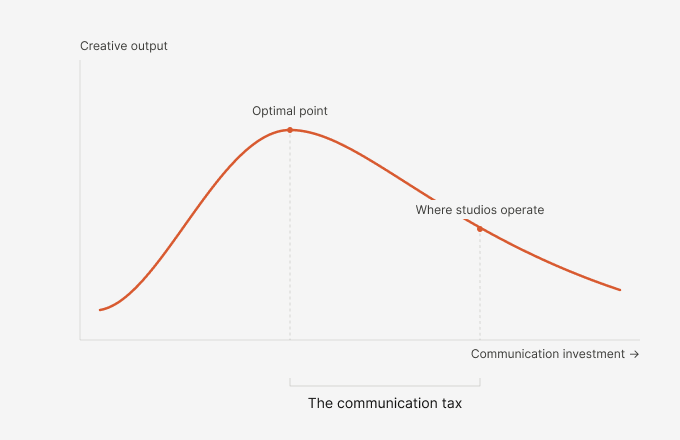
The work became more aligned and less innovative.
This is the Communication Tax. Every studio pays it, usually without naming it. The clearer the communication system, the more time it consumes, and the time has to come from somewhere. Most often, it comes directly from the work itself.
The question we kept arriving at was whether communication is something studios should keep building manually or whether a system was the right response. We’re less interested in helping studios talk to clients more or less, and more interested in lowering the cost of the conversations.
Whether that’s the right framing is something our research continues to question. But the tax is real. It’s worth naming, even if the answer is not fully developed yet.